
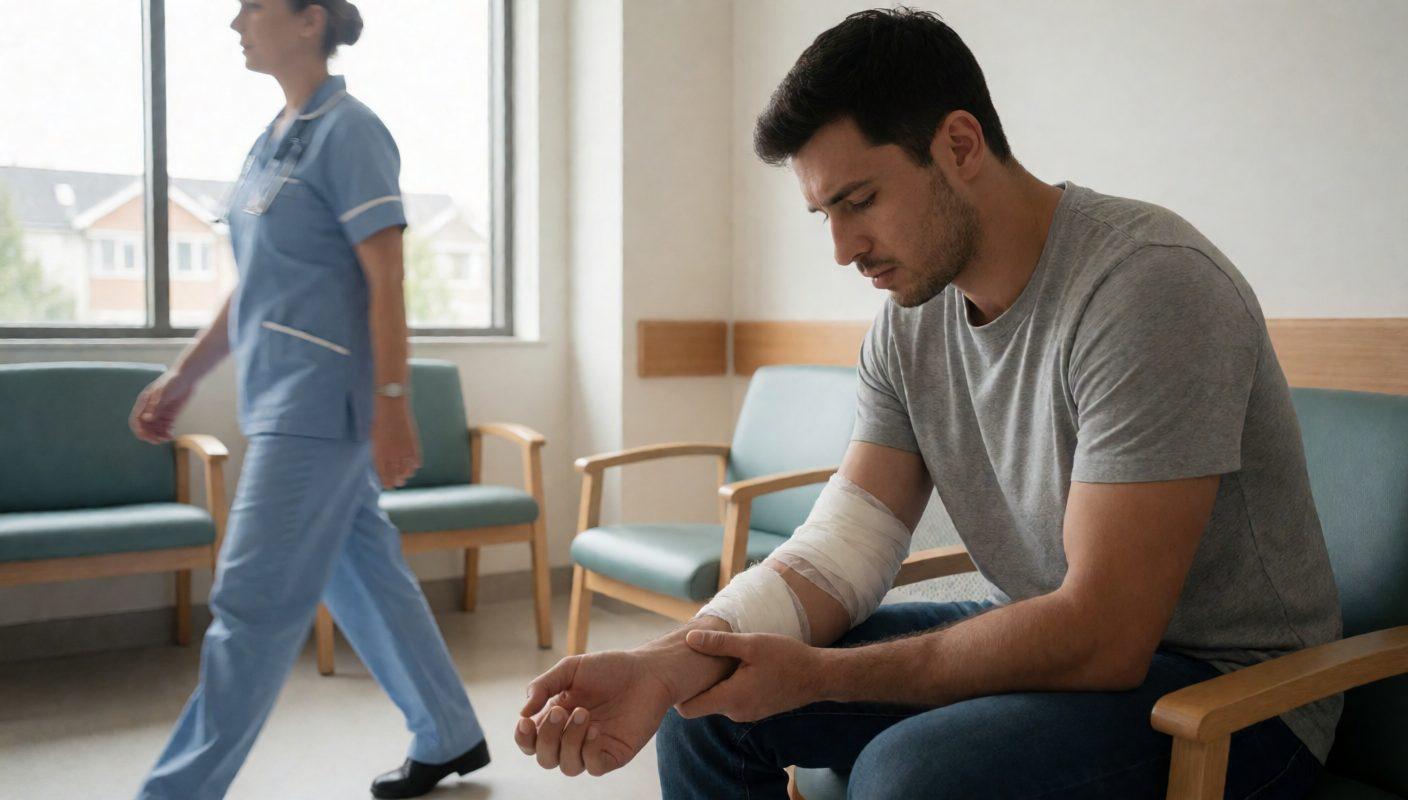
After a fall, sports injury or accident, it can be hard to know whether to head to the emergency room or call an orthopedic office. Some injuries need care right away, and others can wait a day or two for a proper exam. This guide helps you tell the difference and tells you what to do in the meantime.
Go to the ER or call 911 right away for these
Some signs mean the injury is an emergency. Do not wait for an appointment if you see any of the following:
- An open fracture, where bone or a deep wound is visible, or bone has broken through the skin.
- An obvious deformity, where an arm, leg, finger or joint looks bent, twisted or out of place.
- Numbness, tingling, a pale, blue or cold hand or foot, or no pulse below the injury.
- A suspected dislocation, where a joint looks wrong and cannot move.
- Heavy bleeding that does not stop with firm pressure.
- A head injury with loss of consciousness, confusion, repeated vomiting, severe headache or unusual sleepiness.
- Neck or back pain after a serious fall or accident, or any weakness or loss of feeling in the arms or legs.
- Loss of bladder or bowel control after a back injury.
- A serious accident, such as a car crash or a fall from a height.
- Chest pain, trouble breathing or signs of a heart problem.
First aid while you wait for help
Keep the injured area still. Do not try to straighten a bent limb or push a joint back in. For an open wound, cover it with a clean cloth and apply gentle pressure to control bleeding.
If you suspect a neck or back injury, do not move the person unless there is immediate danger. Let emergency responders handle it. Do not eat or drink anything in case surgery is needed, and keep the person warm and calm.
Injuries that can wait for an orthopedic visit
Many bone and joint injuries are urgent but not life threatening. If the limb is in a normal position, circulation and feeling are normal, and there is no open wound, you can usually be seen by an orthopedic doctor within a day or two. Examples include a swollen ankle after a twist, a sore wrist after a fall, a possible stress fracture, knee pain after a sports injury and shoulder pain after a tumble.
While you wait, use the basics: rest the area, raise it above heart level, apply ice wrapped in a cloth for short periods, and use a sling, wrap or brace for support if you have one. Avoid putting weight on a painful leg or ankle until it is checked.
Many people hesitate because they worry about overreacting. It is far better to be checked and told you are fine than to wait on a serious injury. If you are unsure, call 911 or go to the nearest ER, and let the staff decide. You can always follow up with an orthopedic doctor afterward.
Why the follow-up visit still matters
If you went to the ER, you are not done. ER teams stabilize the injury and rule out emergencies, and then they often refer you on for ongoing care. An orthopedic doctor can review your X-rays, confirm the diagnosis, decide whether a cast or surgery is the right path, and plan your recovery.
Do not skip follow-up. Fractures can shift in a splint, and swelling that goes down can change how a cast fits. Missed follow-up can lead to a bone that heals in the wrong position or a joint that stays stiff.
What to bring and what to ask
Bring your photo ID, insurance card, a list of medicines and any paperwork or images from the ER. If your injury happened at work or in a car accident, tell us, since those cases have their own paperwork and coverage.
Useful questions include what exactly is injured, whether surgery may be needed, how long you will be in a cast or brace, when you can return to work and activity, and what warning signs to watch for at home.
When to see an orthopedic doctor
When in doubt, choose safety. Call 911 or go to the ER for open fractures, obvious deformity, a numb, pale or cold limb, a suspected dislocation, a head injury, or a serious accident. Once you are stable, or for injuries that are painful but not an emergency, an orthopedic doctor can take over your care. Able Orthopedic & Sports Medicine in Forest Hills has in-office X-ray, fracture care, sports medicine and care for work and No-Fault car accident injuries. Call (718) 897-2228 or book online.
Common questions
Should I go to the ER for a possible broken bone?
Go if the limb is deformed, the bone is through the skin, the area is numb or cold, or the pain is severe. Otherwise, an orthopedic visit within a day or two is usually fine.
Can I be seen by an orthopedic doctor after the ER?
Yes. Follow-up care after the ER is common and important for planning treatment and recovery.
Do you see work and car accident injuries?
Yes. Able Orthopedic & Sports Medicine treats work injuries and No-Fault car accident injuries.
This article is for general education and is not a substitute for a visit with a doctor. If you think you have a medical emergency, call 911.